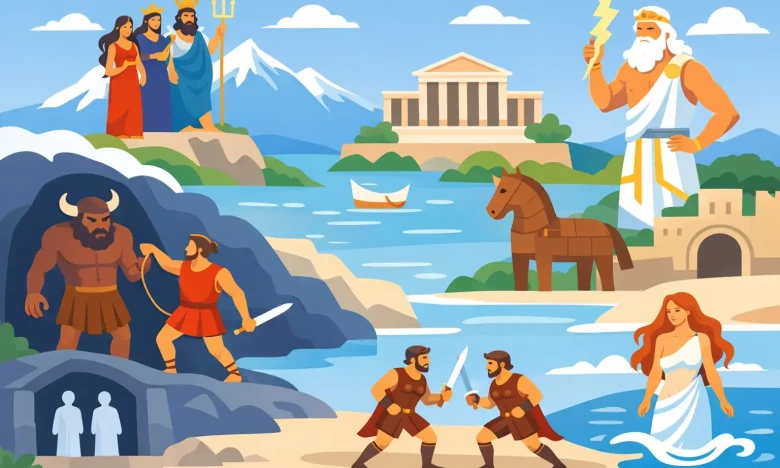




A trip to Greece or the ancient lands surrounding it is like embarking on a mythological journey… Walking on the stone steps of a temple and imagining stories stretching back thousands of years inevitably transports one to another time. These places, each corner of which is home to a legend, impress visitors not only visually but also with the stories they tell.
In this article, I've compiled 10 impressive locations that are home to some of the most famous and well-known stories from Greek mythology. From mountains believed to be the birthplace of the gods to temples where prophecies were whispered; from ancient cities where heroes left their mark to islands where legends took shape, this list offers an inspiring route for those who want to combine mythology with travel.
If you enjoy not only taking photos of the places you visit but also learning their stories, then this list is for you. Ready? Let's step into the magical world of Greek mythology together and begin exploring the lands where legends were born.
1. The Center of Prophecies: The Ancient City of Delphi (Greece – Delphi)
Mythological StoryDelphi is considered one of the most sacred centers in Greek mythology, dedicated to Apollo, the god of prophecy. According to legend, Apollo declared this land sacred by killing the giant serpent Python that lived here, and chose Delphi as the place where he would communicate with humanity.
The Temple Where Prophecies Are Whispered
The oracle Pythia, who served at the Temple of Apollo in Delphi, conveyed the god's messages to people. Kings, commanders, and the common people came here to receive answers to their questions about the future. However, the answers given were often poetic and open to interpretation. This mysterious language made Delphi even more legendary.
The Belief in "The Center of the World"
According to mythology, Zeus sent two eagles to fly from opposite ends of the world, and they met at Delphi. Therefore, this place became known as Omphalos, meaning "the navel of the world." The Omphalos stone, displayed in the museum today, is a symbol of this belief.
Delphi today
Today, Delphi is a fascinating destination for both mythology enthusiasts and travelers. Walking through this ancient city nestled among the mountains, it's possible to feel the atmosphere where people questioned their destinies thousands of years ago. It is one of the rare places where history and legend intertwine.
2. Home of the Gods: Mount Olympus (Greece – Litochoro)
Mythological StoryIn Greek mythology, Mount Olympus is known as the sacred place where the gods lived. It was believed that Zeus, the king of the gods, along with Hera, Athena, Apollo, Artemis, Ares, and the other Olympian gods, resided there. Olympus was envisioned not just as a mountain, but as a divine palace from which the gods ruled the world.
Zeus and the Meeting of the Gods
According to legends, Zeus hurled his lightning bolts from the summit of Mount Olympus, where the gods gathered to decide the fate of humanity. The gods were immortal and lived on Olympus in eternal feasting, music, and splendor. Therefore, Olympus became a symbol of power and might.
Why is this so important?
Because the summit of Mount Olympus is often shrouded in clouds, people in ancient times considered it "inaccessible" and "sacred." Its proximity to the sky further reinforced the belief that the gods resided there.
Mount Olympus today
Today, Mount Olympus is a popular destination for both mythology enthusiasts and nature lovers. Hikes to its summit offer not only breathtaking views but also the glimpses of millennia-old legends. Standing there and looking up at the sky, it's almost impossible not to imagine Zeus wielding his lightning bolts.
3. The Minotaur's Labyrinth: The Palace of Knossos (Greece – Heraklion)
Mythological StoryThe Palace of Knossos is home to one of the darkest and most famous stories in Greek mythology: the legend of the Minotaur. According to the legend, King Minos commissioned the architect Daidalos to build a giant labyrinth to hide the Minotaur, a creature that was half-human and half-bull. It was almost impossible for anyone who entered this labyrinth to escape.
The Story of Theseus and Courage
Theseus, a hero and one of the young sacrificial victims sent from Athens, volunteers to kill the Minotaur. Ariadne, daughter of King Minos, gives Theseus a magical rope to escape the labyrinth. After defeating the Minotaur, Theseus manages to escape the labyrinth alive thanks to this rope. This story illustrates how intelligence and courage together triumph.
The Real Equivalent of the Maze
The complex plan of the Palace of Knossos, its narrow corridors and numerous rooms, have led people to associate it with the legendary labyrinth. Therefore, Knossos is one of the most impressive places where mythology and architecture intertwine.
Today Knossos
Today, as you explore the Palace of Knossos, wandering among the frescoes, columns, and palace ruins, you feel as if you are walking through a legend. Imagining the footsteps of the Minotaur and contemplating Ariadne's rope makes this place far more special than an ordinary ancient city.
4. The City of the Goddess Athena: The Acropolis of Athens (Greece – Athens)
Mythological StoryA contest took place between Athena, the patron goddess of Athens, and Poseidon, the god of the sea, over who would name the city. Poseidon struck the ground with his spear, causing salty water to gush forth, while Athena offered the people an olive tree as a gift. The people chose the olive tree, symbolizing peace and abundance, and the city became known by Athena's name: Athens.
The Meaning of the Parthenon
The Parthenon Temple, the most magnificent structure on the Acropolis, is dedicated to Athena. Ancient Athenians viewed it not merely as a temple, but as a symbol of wisdom and protection. Its construction on the highest point of the city symbolizes Athena's dominion over Athens.
Symbol of Wisdom
Athena is known as the goddess of wisdom, art, strategy, and justice. The owl figure is also her symbol. The reliefs and sculptures found around the Acropolis clearly reflect this mythological identity.
Today the Acropolis
Today, when you climb the Acropolis, you see both the view of Athens and the traces of a millennia-old legend at the same time. The story of the olive tree seems to still be whispered among the stone columns. It is one of the places where mythology and history merge most powerfully.
5. Temple of the Healing God: Ancient Theatre of Epidaurus (Greece – Argolis)
Mythological StoryEpidaurus is one of the most important centers dedicated to Asclepius, the god of healing. In ancient Greece, patients came here not only for treatment but also believing that the god would show them the path to healing in their dreams. Therefore, Epidaurus was considered both a health center and a sacred healing place.
Healing Through Dreams
Patients would sleep in the Temple of Asclepius and recount their dreams to the priests. The priests would interpret these dreams and offer treatments. This practice was a very special ritual where medicine and faith intertwined, making Epidaurus unique from a mythological perspective.
The Mystery of Theatre
The ancient theater of Epidaurus is famous for its impeccable acoustics. It is said that even a whispered word from the top row could be heard from the stage. In ancient times, it was believed that the plays staged here healed people's souls. Therefore, it was not only a place of entertainment but also a place of spiritual healing.
Epidaurus today
Today, when you visit Epidaurus, you are both amazed by the impressive architecture of the theater and contemplate how, thousands of years ago, people came here seeking healing. Sitting in silence and gazing at the stone steps, it's as if the story of Asclepius is still echoing in these lands.
6. The Gate to the Underworld: Nekromanteion (Greece – Epirus)
Mythological StoryThe Necromanteion is one of the most mysterious sacred sites in Greek mythology, believed to be a place where one could communicate with Hades, the god of the underworld. In ancient times, people believed they could speak with the spirits of their deceased loved ones and receive answers to their questions about the future. Therefore, the Necromanteion has gained a reputation as a place where fear and curiosity intertwine.
Spirit Communication Rituals
Visitors to this place would observe long fasts and undergo various purification rituals. The aim was to prepare themselves for contact with the spirit world. The temple's dark and narrow corridors were part of this mystical journey, feeling like a gateway to another world for the visitors.
Between Prophecy and Fear
In ancient Greece, this place was both a center of prophecy and a sacred place of fear. People regarded the messages they received from the Necromanteion as divine commands and shaped their lives accordingly. In this respect, it offered a dark wisdom, in stark contrast to the luminous oracles of Delphi.
Today Nekromanteion
Even today, when you visit this ancient site, the stone walls, the underground passages, and the dim atmosphere still create an eerie effect. This place, home to one of the darkest stories in mythology, reminds us that Greek mythology was not just about gods and heroes, but also about confronting death and the unknown.
7. The Birthplace of the Goddess of Love: Kythira Island (Greece – Kythira)
Mythological StoryKythira Island is considered one of the birthplaces of Aphrodite, the goddess of love and beauty. According to legend, Aphrodite was born from sea foam and first set foot on the shores of this island. Therefore, Kythira has been a symbol of love, passion, and beauty for centuries.
Goddess from the Sea
According to mythology, Aphrodite was born from the foam formed from the pieces of the sky god Uranus that fell into the sea. The waves carried her to the shores of Kythira. This scene has inspired countless paintings and sculptures throughout art history. The birth of Aphrodite represents pure beauty emanating from nature.
Love and Rituals
In ancient times, people came to Kythira to offer sacrifices to Aphrodite and to pray for marriage and love. The island was considered a sacred stop, especially for young couples and those wishing to marry.
Today Kythira
Today, Kythira still preserves its mythological identity with its tranquil beaches and romantic atmosphere. Walking among the rocky shores and listening to the sound of the sea, it's easy to imagine Aphrodite rising from the sea. For those seeking a holiday steeped in mythology, Kythira is a hidden paradise.
8. Where Hercules Proved His Strength: The Ancient City of Nemea (Greece – Corinth)
Mythological StoryNemea is known as the place where Heracles, one of the most famous heroes of Greek mythology, completed the first of his twelve labors. This labor was to kill the fearsome Nemean Lion, whose skin could not be pierced by any weapon. When his sword and arrows proved useless, Heracles defeated the beast by strangling it with his bare strength and began to wear its skin as armor.
The Story of the Invincible Lion
The Nemean Lion was a legendary creature that lived in caves and struck fear into the hearts of the local people. No one could defeat it. Hercules' defeat of this monster shows that he was not only strong but also an intelligent and determined hero. This story has become one of the symbols of courage and perseverance.
Nemea Games
Nemea is famous not only for this legend but also for the Nemean Games, which were held in ancient times. These sporting competitions were organized in honor of the gods, similar to the Olympian Games. Thus, Nemea became an important center both mythologically and culturally.
Nemea today
Today, while visiting the ancient city of Nemea, it is possible to see the caves where Hercules fought the lion and the ruins of the Temple of Zeus. Wandering among the quiet stone paths, it is quite impressive to imagine this epic battle, recounted thousands of years ago.
9. The Scene of the Trojan War: Ancient City of Troy (Türkiye – Çanakkale)
Mythological StoryThe ancient city of Troy was the site of the Trojan War, one of the most epic stories in Greek mythology. According to legend, the war, which began with Prince Paris of Troy abducting Queen Helen of Sparta, lasted for ten years. This war turned into a great struggle in which even the gods took sides.
The Legend of the Trojan Horse
The most famous event that brought an end to the war was the Trojan Horse trick. Greek soldiers built a giant wooden horse, hid inside, and tricked the Trojans into bringing it into the city. At night, the soldiers emerged from the horse, opened the city gates, and Troy fell. This story is one of the best-known mythological examples illustrating that intelligence can sometimes be more effective than brute force.
Achilles and Hector
The most unforgettable heroes of the Trojan War are Achilles and Hector, the Trojan prince. Achilles is said to have been almost immortal, with only his heel being a weak point. Therefore, the expression "Achilles' heel" has survived to this day.
Troy today
Today, when you visit the ancient city of Troy, you can see the remains of the city walls, the excavation sites, and the iconic Trojan Horse. Walking through this land, it's almost impossible not to imagine the battle scenes described in Homer's epics. It is one of the most impressive destinations where mythology and history intertwine.
10. Races in Honor of the Gods: Ancient City of Olympia (Greece – Elis)
Mythological StoryOlympia is known as the birthplace of the Olympian Games, held in honor of Zeus, the king of the gods. According to legend, these games began to honor Zeus and glorify his power. Here, sport was not just a physical competition; it was a sacred ritual dedicated to the gods.
Temple and Statue of Zeus
The most magnificent structure in Olympia was the Temple of Zeus. Its colossal statue of Zeus was considered one of the Seven Wonders of the Ancient World. Made of gold and ivory, this statue depicted Zeus seated on his throne and was the most tangible symbol of divine power for the people of that era.
Sports and Mythology Combined
Only male athletes could participate in the ancient Olympian Games, and the competitions were held in the presence of the gods, creating an atmosphere of great respect. Winners received crowns made of olive branches instead of medals. This showed that victory held honorary, rather than material, value.
Today at Olympia
Today, while visiting Olympia, you can walk among the stadium ruins, temple columns, and traces of statues. Wandering through these lands where people raced to Zeus thousands of years ago allows you to experience firsthand how intertwined sport and mythology are. Olympia is one of the strongest examples showing that Greek mythology was nourished not only by legends but also by daily life.