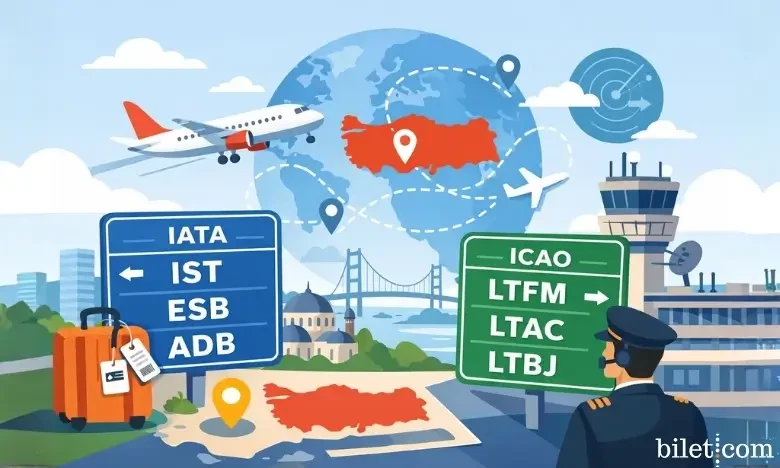




In fact, airport codes are part of a critical system that ensures the orderly, fast, and error-free management of air traffic worldwide. Especially in countries with high flight traffic – and Turkey is quite active in this regard – these codes prevent confusion and standardize communication.
This article will explain what airport codes are, the differences between IATA and ICAO codes, why they are so important, and detail the codes used at airports in Türkiye. If you're curious about the system behind these codes you see while traveling, you're in the right place.
What are IATA and ICAO Codes?
Airport codes are not actually uniform; they are determined by two different international systems: the International Air Transport Association (IATA) and the International Civil Aviation Organization (ICAO). Although both play a critical role in the aviation world, their purposes and structures differ.IATA Codes
IATA codes are the most common codes passengers encounter. The three-letter abbreviations you typically see when buying plane tickets, on baggage tags, or on flight screens belong to this system.These codes are designed to be short, memorable, and practical to facilitate the passenger experience. They are particularly effective in standardizing booking systems and ticketing processes.
ICAO Codes
ICAO codes, on the other hand, have a more technical application. They are used in air traffic control, flight planning, and operational processes. These codes generally consist of four letters and have a more systematic structure.ICAO codes for airports in Türkiye generally begin with “LT”. This prefix represents the country code.
Why do airport codes exist?
Tens of thousands of flights take place around the world every day, and each of these flights moves in a coordinated manner between different cities, countries, and airports. This is where airport codes come into play. Because for such a busy and complex system to function smoothly, a standard, fast, and error-free communication language is required.1. To Prevent Confusion
There are many cities and airports around the world with the same or similar names. For example, even saying "Istanbul" might bring to mind more than one airport. To prevent such confusion, each airport is assigned a unique code.For example:
- Istanbul Airport → IST
- Sabiha Gökçen Airport → SAW
2. Establishing International Standards
Aviation is a completely global system. Countries speaking different languages and using different alphabets need to find common ground. This is where the codes established by the International Air Transport Association and the International Civil Aviation Organization create a universal standard.Thanks to this standard, an officer in Japan and a pilot in Türkiye can communicate seamlessly using the same code.
3. Increasing Operational Speed
Time is of the essence at airports. Processes such as flight scheduling, baggage handling, refueling, and passenger guidance need to move quickly. Using short codes instead of long airport names significantly speeds up these processes.ICAO codes, in particular, greatly facilitate pilots' preparation of flight plans and communication with air traffic control.
4. Compatibility with Technological Systems
Many technologies, such as reservation systems, flight tracking software, and baggage management systems, are built upon these codes. Standard three- or four-letter codes allow for much faster and more accurate data processing.For example, when you buy a plane ticket, the system processes the transaction in the background using codes directly, not city names.
5. Becoming Part of a Global Network
Every airport is part of a vast global aviation network. To be part of this network and integrate with other airports, it needs a standardized identity. Airport codes provide precisely this identity.In short, these seemingly small codes are actually one of the most critical, yet unseen, building blocks of the aviation industry. In the next section, we will examine all the codes of active airports in Türkiye in a detailed table.
Active Airports and their Codes in Türkiye
Turkey, thanks to its geographical location, is an important air transport bridge between Europe, Asia, and the Middle East. Therefore, the country has numerous active airports serving both domestic and international flights. The table below shows the IATA and ICAO codes of the main active airports in Türkiye.| City | Airport | IATA Code | ICAO Code |
| Adana | Adana Şakirpaşa Airport | ISLAND | LTAF |
| Pain | Ağrı Ahmed-i Hani Airport | AJI | LTCO |
| Ankara | Esenboğa Airport | ESB | LTAC |
| Antalya | Antalya Airport | AYT | LTAI |
| Balıkesir | Balıkesir Koca Seyit Airport | EDO | LTFD |
| Batman | Batman Airport | HONEY | LTCJ |
| Bursa | Bursa Yenişehir Airport | YEI | LTBR |
| Canakkale | Canakkale Airport | CKZ | LTBH |
| Denizli | Denizli Çardak Airport | DNZ | LTAY |
| Diyarbakır | Diyarbakır Airport | DIY | LTCC |
| Elazığ | Elazığ Airport | EZS | LTCA |
| Erzurum | Erzurum Airport | ERZ | LTCE |
| Gaziantep | Gaziantep Airport | GZT | LTAJ |
| Hatay | Hatay Airport | HTY | LTDA |
| Iğdır | Iğdır Martyr Bülent Aydın Airport | IGD | LTCT |
| Istanbul | Istanbul Airport | IST | LTFM |
| Istanbul | Istanbul Sabiha Gökçen Airport | SAW | LTFJ |
| Izmir | Adnan Menderes Airport | ADB | LTBJ |
| Kahramanmaraş | Kahramanmaraş Airport | KCM | LTCN |
| Kars | Kars Harakani Airport | KSY | LTCF |
| Kayseri | Kayseri Erkilet Airport | ASR | LTAU |
| Konya | Konya Airport | KYA | LTAN |
| Kütahya | Victory Airport | KZR | LTBZ |
| Malatya | Malatya Airport | MLX | LTAT |
| Mardin | Mardin Airport | MQM | LTCR |
| Muğla (Bodrum) | Milas-Bodrum Airport | BJV | LTFE |
| Muğla (Dalaman) | Dalaman Airport | DLM | LTBS |
| Ordu-Giresun | Ordu-Giresun Airport | OGU | LTCB |
| Rize-Artvin | Rize-Artvin Airport | RZV | LTFO |
| Samsun | Samsun-Çarşamba Airport | SZF | LTFH |
| Sinop | Sinop Airport | NOP | LTCM |
| Sivas | Sivas Nuri Demirdag Airport | VAS | LTAR |
| Sanliurfa | Şanlıurfa GAP Airport | GNY | LTCS |
| Trabzon | Trabzon Airport | TZX | LTCG |
| Van | Van Ferit Melen Airport | VAN | LTCI |
How are airport codes determined?
When you buy a plane ticket, those three-letter codes sometimes seem very logical, and sometimes they make you wonder, "What does this have to do with this city?" In fact, determining airport codes is a much more systematic process than you might think, but it's also heavily influenced by historical and practical details.City Names and Abbreviations
Often, IATA codes are derived from the name of the city or region where the airport is located. Therefore, some codes are quite intuitive.For example:
- Istanbul Airport → IST (Istanbul)
- Ankara Esenboğa Airport → ESB (Esenboğa)
Historical and Local References
Some airport codes are derived not directly from the city name, but from historical or local references. This can sometimes cause the codes to look different than expected.For example:
Sabiha Gökçen Airport → SAW
The "SAW" here is derived from the international spelling of Sabiha Gökçen's surname, after whom the airport is named (Sabiha Gökçen → "Sabiha Gokcen" → "SAW" is not actually a direct, one-to-one letter equivalent, but a more appropriate combination). Therefore, a direct, one-to-one abbreviation isn't always the preferred approach; suitability and usability are also important.
Having More Than One Airport in the Same City
Large cities may have multiple airports, in which case a different code needs to be assigned to each one.For example, Istanbul:
- Istanbul Airport → IST
- Sabiha Gökçen Airport → SAW
Why do some codes seem illogical?
Some code might seem unrelated to the city at first glance. There are several reasons for this:- It was previously used by another airport.
- The city's old name or its equivalent in another language.
- Code combinations are limited (not every 3-letter combination can be used)
How does the International Air Transport Association determine codes?
IATA considers several key criteria when determining airport codes worldwide:- The code must not have been used before.
- It should be as closely associated as possible with the city or airport name.
- To avoid confusion in international usage.
- It should be short, readable, and practical.